
The chair is vinyl and it faces the bed. Someone has angled the television toward the door and left it muted. You have been here twenty minutes. You asked about lunch, and about her knee, and whether the new aide is any good, and she answered all three, and now there is an hour left and the two of you are looking at each other.
Nothing has gone wrong, which is the confusing part. Nobody is upset. You are not fighting. You drove forty minutes to be here and you meant every mile of it. There is simply nothing left to say, and there is a great deal of time left in which to not say it, and the clock above the door moves the way clocks move in that building, which is to say barely.
I started spending time in care facilities without expecting that to be the hard part. I expected the sadness. I did not expect the arithmetic.
Everyone gives you the same advice, and the people giving it have a stake
Search for what to talk about when you visit a parent in a nursing home and the results are remarkably consistent. Ask about their childhood. Bring funny cartoons. Share a scrapbook. Ask what they think of the new activities director.
Look at who published those pages and a pattern shows up fast. Nursing home chains. Hospice companies. Senior living referral sites that get paid when you place someone. Advice about visiting your mother, written by the company you pay to house your mother, is not exactly disinterested, and it reads the way brochures read.
The deeper problem is that the advice does not work, and it fails in a specific way. A list of conversation starters treats the hour as a supply problem, as though you arrived underprepared and would have been fine with better material. So you bring twelve questions. She answers nine of them in eleven minutes, gives one-word answers to two, and does not hear the last one. Now the list is gone, the hour is not, and you have managed to fail at the one thing you prepared for.
Some months ago I asked a forum of people caring for aging parents what they actually do. Not what they think they should do. What happens in the room.
The thread drew about a hundred and fifty replies.
Almost nobody named something to talk about
I went through every reply and sorted them. Roughly sixty distinct suggestions, and one of them, exactly one, was a conversation topic standing on its own.
The rest named a thing.
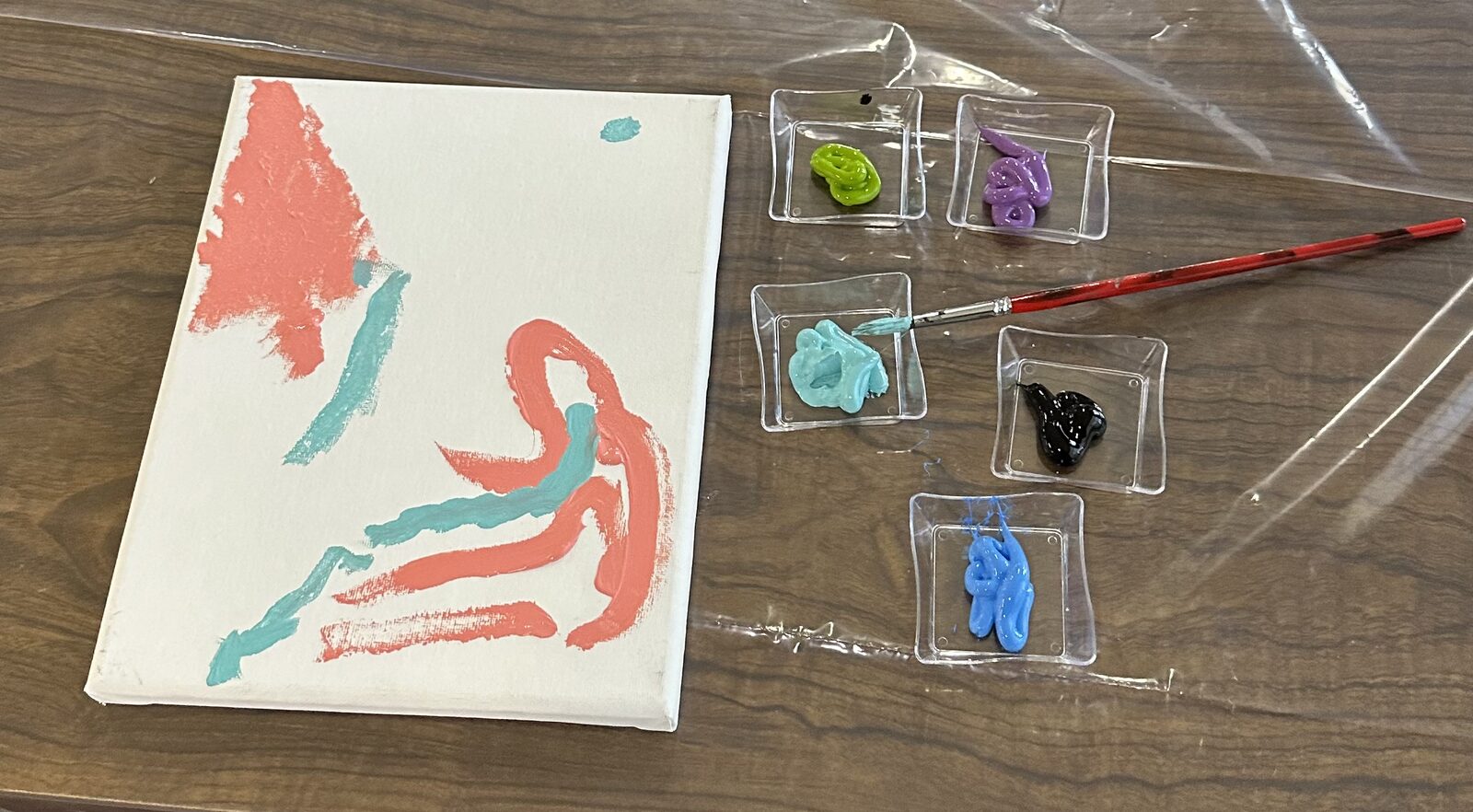
Jigsaw puzzles, over and over, from nine different people. A bird feeder hung outside a window. Photo albums. Coffee-table books. Old films the person had already seen. Jeopardy at six thirty. Baseball. Mexican train dominoes. Coloring books. A radio left on low. A potted plant that needed water between visits. Waffle House.
None of these people were describing conversation. They were describing an object placed between two people, and the reason it works is not that it passes the time. It is that it changes who is responsible for the silence.
A conversation makes the silence somebody's fault. Two people facing each other have one job, and when the job stops getting done the failure sits in the middle of the room where both of them can see it. She feels it as being boring. You feel it as not trying hard enough. Neither of you says so, and the hour gets longer.
Put a puzzle on the table and the job belongs to the puzzle. You are no longer two people failing to talk. You are two people looking at the same thing, and looking at the same thing is what people who love each other have always done instead of talking. It is why families watch television together. It is why fishing exists.
Connection here is side by side rather than face to face. That is the whole idea, and everything below is a way of arranging it.
Bring an object, not a topic
The most-upvoted answer in the thread came from someone whose mother can no longer do much of anything. They set up a card table in her room with a jigsaw on it. Staff work on it. Visitors work on it. Their mother sorts pieces by color, or pulls out anything with a flower or a leaf on it, which is a thing she can still do.
Since December, four puzzles have been completed. None of them by her.
That detail is the whole lesson, and it is the one every guide gets wrong. The object does not have to be finishable. It does not have to be an activity she can succeed at. It only has to be something for the two of you to point your attention at, with a small job inside it that she can still hold. Find the flowers. Where do the edges go. Which of these is blue.
Someone hung a bird feeder outside their mother's window. Sometimes, the reply said, the two of them just watch the birds. Further down the thread came one more line, and it is the one I keep thinking about: I get texts about birds.
The feeder was never an activity. It gave her something to notice, and having something to notice gave her something to report. That is a different and better thing than a topic, because a topic runs out and a window does not.
Others move the whole idea out of the building. Sunday dinner every week, because it gives everyone something to focus on. A grandfather in assisted living taken to Waffle House, chosen for reasons that turn out to be quite sophisticated: the food is fast, you can linger or not, and nothing about the place demands that anyone behave well. The grandchild who took him was still proud, years later, of having finally found a restaurant a famously picky man liked. Waffle House became their thing for the last year of his life.
Wherever it is, the meal is doing the same work the puzzle does. Nobody has to perform. There is a menu to look at.
Use the channels that outlast conversation
Talking is the first thing to go and people treat it as the only thing there was. It is not even the strongest one.
Music
It came up more than anything except puzzles, and the best account of it in the thread came from someone whose father could still play guitar in memory care. When he played, they wrote, his eyes lit up and their dad was back. He would play the same song four times in a row, which was fine. Other residents heard it and came in. Some of them no longer spoke at all, and they sang every word of Red River Valley and You Are My Sunshine.
The last line was a verdict: it is deeply rooted, and it is way underused.
Hearing
This is the unglamorous one and it may matter most. One person brought their father headphones and cued up music from his era on a phone. Across three years in skilled nursing, they wrote, the most engagement they ever got came in the moments when he could actually hear them. It is worth considering that the conversation may have ended for mechanical reasons rather than cognitive ones, and that a pair of headphones is a cheaper experiment than another list of questions.
Touch
Almost nobody writes about this, and the people in that room think about it constantly. One reply pointed out that outside of hygiene and medical care, a great many older people are not touched at all. Holding a hand. Brushing hair. Putting lotion on hands that have gone dry. Another described a father in skilled nursing saying, plainly and without embarrassment, I know we're out of things to talk about, but can you just hold my hand for a bit? He would hold it and sleep, and he said it was the only rest he got. His child used the other hand to scroll a phone.
I would have found that sad a few years ago. I do not now. He knew exactly what he needed, he asked for it, and it was available.
Outside
Fresh air, a courtyard, a wheelchair pushed around the block. These came up constantly, and I suspect they work because the outdoors supplies its own content. Something is always happening out there, even when nothing is.
Go shorter, go more often, and bring something for yourself
The advice that most contradicts how families actually behave came from someone who had clearly been thinking about it a long time. Do not build visits up into something long and structured that has to be filled, they wrote. If you live close enough, just stop in. Twenty minutes. Ten. Even five is worthwhile, because it breaks up a day made mostly of monotony.
Several people independently arrived at the same ceiling. Two hours is plenty. An hour, three times a week. One person timed their visits to Jeopardy, arriving at six thirty and leaving at seven forty-five.
And more than one person offered the reminder that undoes the guilt entirely: the visit is tiring for them too. She wants to see you and she is also ninety-one. The long dutiful afternoon may be costing her something you assumed it was giving.
The last piece of it is permission you have to grant yourself. One person brings knitting, which is what lets the silence sit comfortably. Another reads on a Kindle while their father watches television. A third plays Pokémon when their father falls asleep halfway through, and does not appear to feel bad about it.
You do not have to be on for the entire visit. You have to be there. Those are different requirements, and confusing them is what makes people stop coming.
What changes first
The dread goes, and it goes quickly.
Someone in that thread admitted something I suspect a great many people feel and almost nobody says out loud: that they dread visiting their father, not for any lack of love, but because being inside a care facility makes them feel close to panic. They were grateful for the ideas. What the ideas actually offer is not entertainment. It is a way to be in that room without having to hold the whole hour up by yourself.
A puzzle, a window, a record, a hand. Once the hour has somewhere to go, you stop bracing for it in the car.
What changes later
One reply has stayed with me longer than the rest, because the person who wrote it had worked out something on their own that took me a very long time to see.
Bring the old photographs, they said. The ones with people in them nobody has identified yet. Bring a felt-tip pen. And turn on a recorder, because while you are going through the stack she will say things about those people that you did not ask for and would never have thought to ask about.
Write the names on the back. Keep the audio.
Someone else in the thread had learned the other half of it the hard way. Never ask do you know who this is, they said, because it stressed their mother out. It is a test, and a test invites failure. So they followed instead. When their mother lingered on a face or pointed at one, they supplied the name and kept going: oh, I think that's great-uncle Usybius, he always wore the same overalls.
That is the same principle as the puzzle, applied to memory. Do not put her on the spot. Put something in front of her and pay attention to what she reaches for.
And this is where the recorder turns out to be doing something larger than filling an afternoon. The stories that arrive sideways, while you are both looking at a photograph, are the ones a direct question never produces. They come out unguarded, in the middle of something else, exactly the way the honest parts of a life have always come out. They are also the parts that vanish first, because nobody thinks to write down what was said in passing on a Tuesday.
The visit ends at five. That recording does not.
Questions people ask
What do you do when your parent doesn't want to do anything?
This is the most common frustration and it usually means the activity is being proposed as an event. Anything announced can be refused. An object that is simply present, a puzzle left out on a table, a bird feeder already hanging, a record already playing, does not require agreement and often gets participation anyway. Lower the stakes rather than raising the effort.
How long should a visit be?
Shorter than most people assume, and more often if you live close enough. Many experienced families settle around an hour, two at most, several times a week. Visits are tiring for the person being visited as well, and a five-minute stop to say hello genuinely counts. Frequency does more than duration.
What can you do with a parent who can't hold a conversation anymore?
Nearly everything above, and it is worth checking hearing before concluding it is cognitive. Music reaches people who have stopped speaking, sometimes completely: people in memory care who have not spoken in months will sing entire songs they learned as children. Reading aloud works. Looking at photographs works. So does sitting outside, and so does holding a hand.
Is it normal to dread visiting?
Yes, and it is far more common than anyone admits. Dreading the building, the smell, the sound of it, or the version of your parent you find there is not the same as not loving them. It usually means you are carrying the entire hour by yourself. Bring something that carries part of it.
What should I actually bring?
Something to do together, and something to do alone. A puzzle, a photo album, a speaker with their music on it, a meal from anywhere that is not the dining room. Then a book or your knitting for the stretch when they fall asleep, which they will, and which is not a failed visit.
If you want somewhere to start with the photographs, we put together a free guide of 50 questions to ask your aging parent, grouped into seven themes, with some honest advice about asking them without the afternoon turning into an interview. It works best the way the people in that thread use it, which is with something already in your hands.
Bring the photographs. Ask one question. Then look at the picture, not at her, and wait.
A note on the source. The replies described here come from a public thread I posted in an online community for people caring for aging parents, asking what they actually do during a visit. It drew about a hundred and fifty replies, which I read and sorted by hand. The community is not named or linked, because its rules prohibit promotion and pointing at it from a commercial site would breach them. Nothing here is quoted at length and nobody is identified.